Most restaurant owners who ask us about Google Ads have tried it before. Usually one of two things happened. The budget was gone in a week, or the report showed thousands of impressions and nobody could say whether a single extra table was filled.
Both problems have the same root. The campaign went live before anyone decided what it was meant to change.
Google Ads works for a restaurant when three things line up:
- people are already looking for what you serve;
- they are close enough to come in;
- you have room for them when they do.
"Korean BBQ near me" at 6 p.m. on a Tuesday is worth paying for. "Korean BBQ recipe" is not, and neither is a Saturday night when you already have a 45-minute wait.
Where people look is also widening. In DoorDash's 2026 survey of 3,001 U.S. consumers, 22% said they had used an AI tool such as ChatGPT or Gemini to help choose a restaurant. Search ads still catch people at the moment of choice. But the ad is only one part of how a restaurant gets found, and the rest of this guide treats it that way.
This guide covers three things: what Google Ads realistically costs, which campaign type suits which kind of restaurant, and how to tell whether it worked. Where a number comes from our own client accounts, we say so. Where it is an industry average or a planning estimate, we say that too.
If you are still choosing between platforms, read Google Ads or Meta Ads first. In short, Google is strongest when demand already exists, and social is better at creating it.
What Google Ads costs a restaurant
What a click costs
Restaurants are one of the less expensive categories on Google. LocaliQ's 2026 search advertising benchmarks cover more than 13,000 U.S. campaigns. For Restaurants & Food, they report:
- an average cost per click of $2.05
- a click-through rate of 6.83%
- a conversion rate of 8.05%
- a cost per lead of about $30.57
The previous year's report put the all-industry median at $5.26 per click.
Read these as a sense of scale, not a quote. A benchmark is an average across thousands of accounts. "Conversion" can mean a call in one account and a button tap in another. Your own costs will depend on your city, your cuisine, how many nearby restaurants are bidding and how tightly the campaign is set up.
Our own accounts show how wide the range is. One seafood restaurant we manage paid $319 for about 1,880 clicks in a month, an average of $0.17 per click. That is one market and one keyword set, so it is not a number to plan around. It does show how much targeting and competition move the price.
How Google spends your daily budget
This catches many owners out. The figure you enter is an average daily budget, not a fixed daily limit.
Google explains that a campaign can spend up to twice its daily budget on a busy day. Across a month, you are not billed more than 30.4 times the daily figure. A $20-a-day campaign might spend $40 on a Friday, but the month stays capped at about $608.
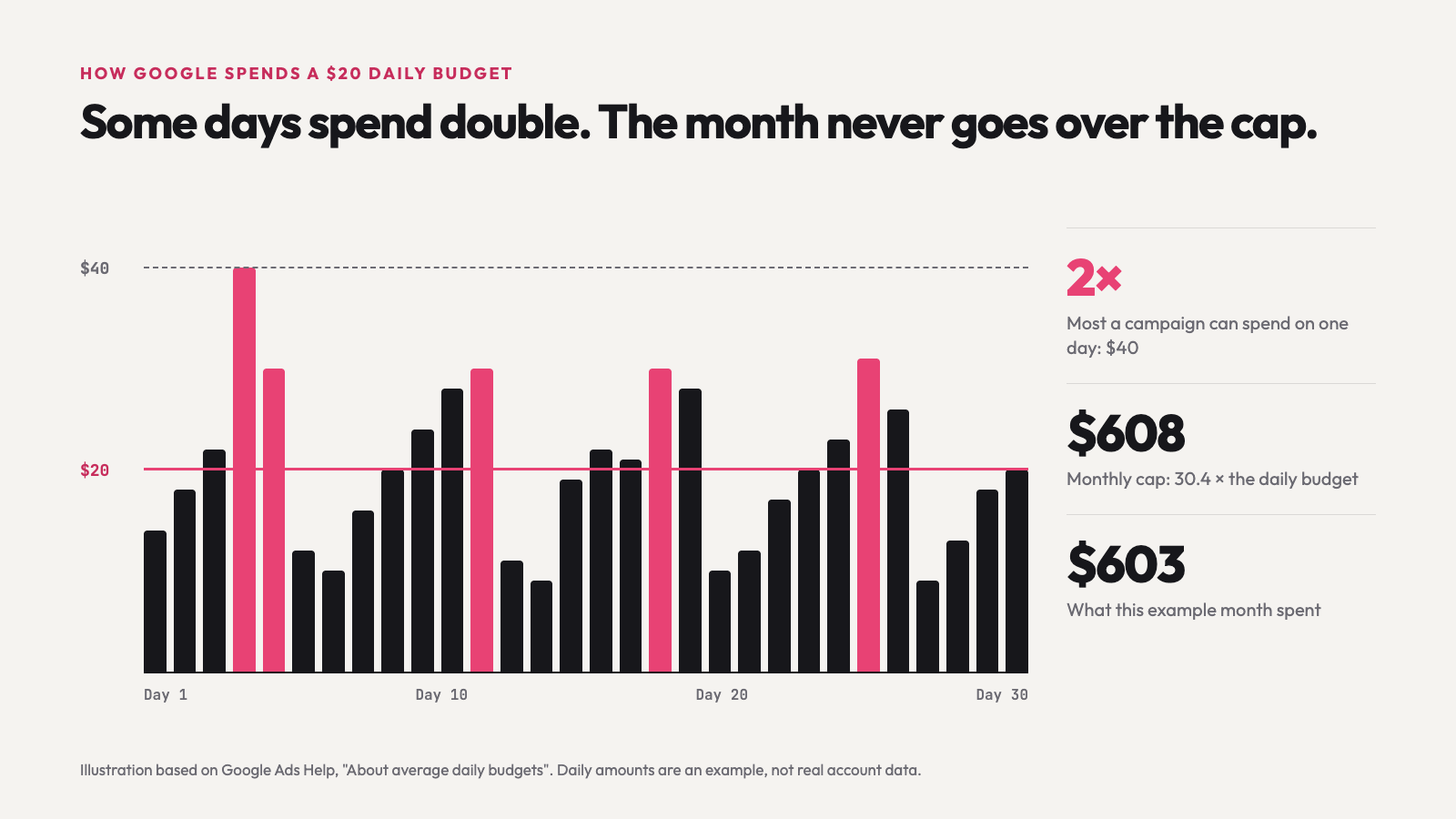
If you need a firm monthly number, divide it by 30.4 and use the result as the daily budget.
Working out a first budget
Start from what you want to happen, not from a round number. Here is a planning example using the benchmark figures above. It is an estimate, not a forecast:
- Average daily budget: $20, about $600 a month
- Cost per click: about $2
- Clicks in a month: about 300
- Share that take a tracked action (call, directions, order click): about 8%
- Tracked actions in a month: about 24
Twenty-four actions are enough to start learning. They are not enough to judge every keyword, so plan on four to eight weeks before drawing firm conclusions.
Two rules matter more than the exact figure.
Spend enough to get a signal. Spread $300 across five campaigns and none of them gathers enough data to read. One focused campaign teaches you more.
Know what a guest is worth before you start. A $30 action is cheap for a $120 dinner for two and expensive for a $14 lunch bowl. Our Budget Planner helps you run these numbers. For the wider question of how much to spend on marketing overall, start with the shift you want to fill, not a percentage of sales.
Ad spend vs management fees
Your ad budget goes to Google. If an agency or freelancer runs the account, their fee is separate. At PandaPath, ads management starts at $299 a month plus ad spend. Whoever you hire, ask to see the two numbers side by side.
Which campaign type fits your restaurant
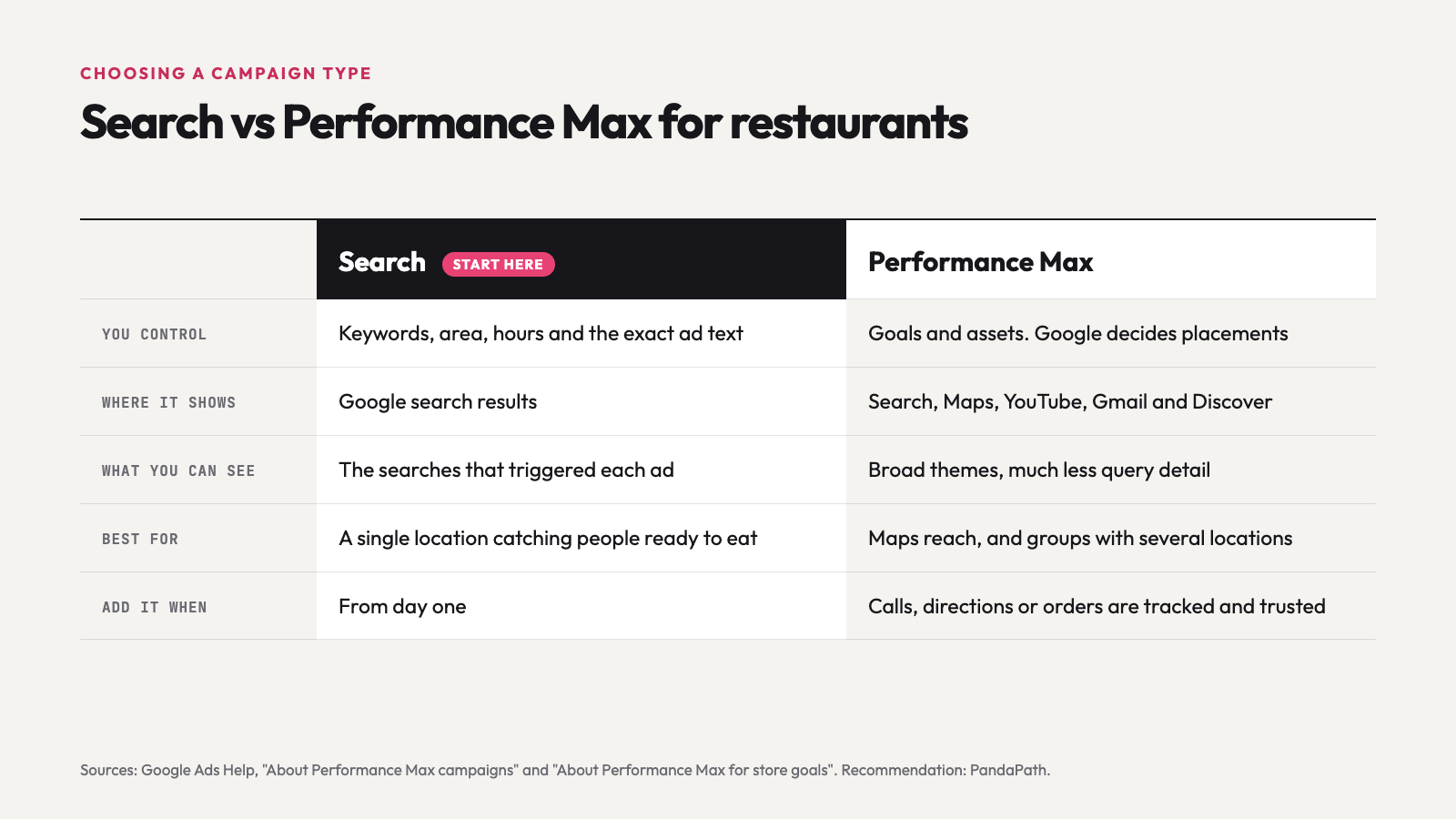
Search: the right start for most single locations
Search campaigns show text ads when someone types a query you have chosen to bid on. For a single-location restaurant this is usually the best first campaign:
- you control the keywords, the area and the hours;
- you can see which searches triggered your ads;
- you can stop paying for the bad ones.
Build a short list of cuisine-plus-intent terms, such as "ramen near me", "ramen open late" or "best pho in [your neighborhood]". Add your own restaurant name, so a competitor cannot sit above you when someone looks you up.
Performance Max: once tracking is solid, or for groups
Performance Max is a single campaign that Google runs across Search, YouTube, Maps, Gmail and Discover. You supply the goals, images, video and text, and Google's automation decides where to show them.
For restaurants, its main appeal is Maps and local placements. A Performance Max campaign with store goals can optimize toward calls and direction requests, even if your business is not eligible for store-visit tracking.
The trade-off is control. You see much less about which searches or placements produced a result. Performance Max also learns from whatever you tell it counts as a conversion. If that is a page view or an accidental tap, it will find you more of those.
Our approach is to add Performance Max once a Search campaign is running and the tracking is trusted. It also makes sense for groups with several locations that each need to show on Maps. Google gives a Search campaign priority when a query exactly matches one of its exact-match keywords, so the two can run side by side.
Maps and your Business Profile
Many restaurant searches end on Google Maps rather than on a website. Ads can appear there, but they work far better when your Google Business Profile is complete: correct hours, a current menu link, recent photos and reviews you have replied to.
Those reviews are part of your ad, whether you plan it or not. In BrightLocal's 2025 consumer survey, only 4% of people said they never read online reviews, and just 7% said they don't expect businesses to reply. Being found is also only half the job, as we explain in Maps visibility is only half the decision.
What to leave for later
- Broad display campaigns. They are cheap per impression and hard to connect to a visit. Save them for a clear reason, such as a new opening.
- Bidding on competitors' names. It is allowed, but it is often expensive and rarely the place to begin.
- Running everything at once. Every extra campaign splits a small budget further.
Setting up the first campaign
Area and hours
Target the distance people will realistically travel for your kind of meal. That might be a couple of miles for weekday lunch and further for a destination dinner.
Google's default location setting also reaches people who have shown interest in your area. For most restaurants, switch to Presence, which targets people who are in or regularly in your area.
Then schedule ads for the hours you want more guests. If Saturday night is already full, put the money on Tuesday lunch.
Keywords and exclusions
Use phrase and exact match for your core terms. Build a negative keyword list on day one with terms like recipe, jobs, hiring, calories, delivery driver and any dish you don't serve. Review the search terms report every week for the first month and keep adding to the list.
Where the click lands
Send people to the page that matches the search. A lunch-special ad should land on the lunch menu with a clear order or call button, not on the homepage. On a phone, the menu, hours, address and the main action should be visible without hunting.
More ad spend will not fix a broken order button.
Measuring results beyond clicks
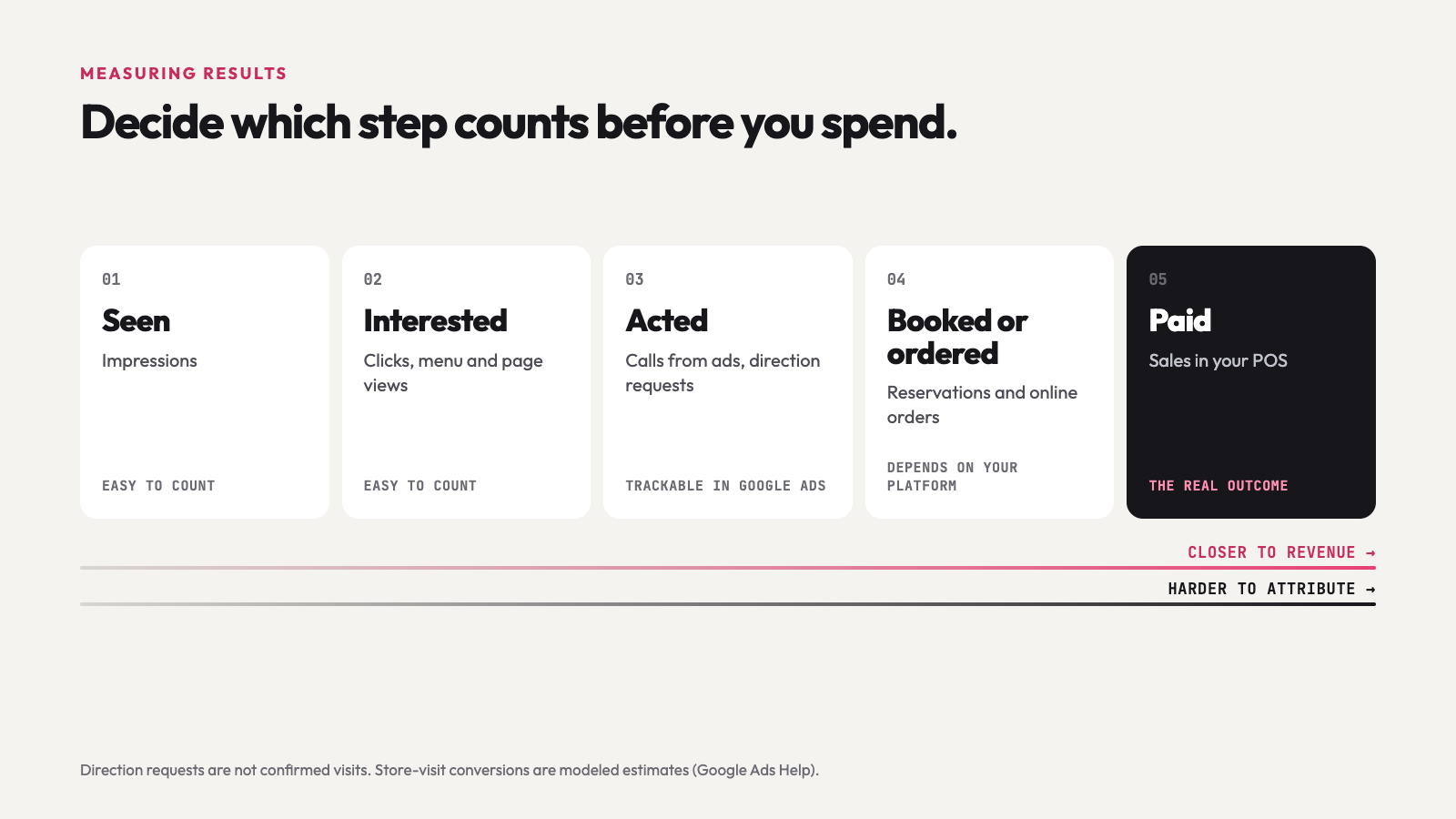
Impressions and clicks tell you the ad was seen. They don't tell you anyone ate with you. Decide what counts as a result before the first dollar is spent, and set up tracking for it.
Calls
Turn on call tracking for calls from ads, and set a minimum call length so wrong numbers and quick hang-ups don't count. A call is a strong signal for reservations, large parties and catering. It is still a call, not a booking.
Direction requests
Google can count direction requests as local actions. They are a useful sign of intent. They are not a confirmed visit, because people change their minds or tap twice.
Online orders and reservations
These are the closest you will get to revenue. How well you can track them depends on your platform:
- If ordering or booking happens on your own site, a conversion tag on the confirmation page works well.
- Many third-party ordering and reservation systems run on their own domain and pass little or nothing back to Google.
Check what your platform supports before you judge the campaign. "No conversions" sometimes means "no tracking".
Store visits
Google offers store-visit conversions, but they are modeled estimates. They also require verified Business Profile locations and enough traffic to meet privacy thresholds. Many single-location restaurants won't qualify. Those that do should read the figures as estimates, not a head count.
What attribution can't tell you
A platform can take credit for a guest who would have come anyway, or miss a guest who saw the ad and walked in a week later. A good month might also be the weather, a holiday or a new menu.
Compare the same weeks last year, change one thing at a time and read your POS alongside the ads report. We go deeper on this in did the clicks create useful demand.
What we have seen in restaurant accounts
Here are two examples from accounts we manage. Names are withheld, and results vary by market, offer and budget.
Ramen restaurant, one month of Google Ads
- 292 phone calls from ads
- 1,922 direction requests
- 1,623 website visits
These are customer actions, not attributed sales, and a direction request is not a confirmed visit. What made them useful was when they happened. The calls and directions showed which hours and offers moved people toward the door, and that shaped the next month's budget far more than the click count did.
Seafood restaurant, one month of Google Ads
- about 1,880 clicks for $319
- an average of $0.17 per click
Cheap clicks are only good news if the next step works. The question we asked was not "how low can the click cost go" but "what did people do after the click".
When to bring in help
You can run a small Search campaign yourself if you have an hour a week, are comfortable reading the search terms report and can set up conversion tracking.
It's worth getting help when:
- the budget is large enough that a wasted week hurts;
- you have several locations;
- you want to use Performance Max; or
- nobody on the team can confirm that tracking works.
If you would like a second opinion on an existing account, our Paid Media team can review it with you. Or start with a free Growth Assessment.
Frequently asked questions
How much should a restaurant spend on Google Ads each month?
There is no single right number. Many single-location restaurants test with a few hundred dollars a month in one focused campaign. Set the budget from what a guest is worth to you and how many actions you need to learn from. Google can spend up to twice the daily budget on a given day, but no more than 30.4 times the daily budget across a month.
What does a click cost for a restaurant?
LocaliQ's 2026 benchmarks put Restaurants & Food at an average of $2.05 per click. Actual costs vary widely by city, cuisine and competition.
Is Performance Max good for restaurants?
It can be, especially for Maps visibility and for groups with several locations. It works best once you already track calls, directions or orders, because it optimizes toward whatever you tell it counts.
How long does it take to see results?
Ads can start showing within a day of approval. Allow four to eight weeks of data before deciding which keywords, hours and offers to keep.
Can Google Ads guarantee more customers?
No. It can put your restaurant in front of people who are already looking. Whether they come in depends as much on your offer, reviews, hours and website as on the ad.
Sources: Google Ads Help on average daily budget, location targeting, Performance Max, Performance Max for store goals, local actions, store visits and call conversions; LocaliQ Search Advertising Benchmarks, 2026 edition; WordStream 2025 Google Ads Benchmarks; DoorDash 2026 Restaurant Industry Trends Report; BrightLocal Local Consumer Review Survey 2025. PandaPath figures come from client accounts we manage, with names withheld.
资料来源
PandaPath Growth Lab 原创内容。文中引用的数据、平台功能和政策均已注明原始来源;标注“假设示例”的内容仅作说明,并非客户案例。